Homework 5 - Arc Nemesis
Your mission: implement a CSP solver for the dreaded task of scheduling meetings!
That's right, we're solving *Calendar* Satisfaction Problems in this one!
If that doesn't excite you, look at this adorably relevant cartoon I found:
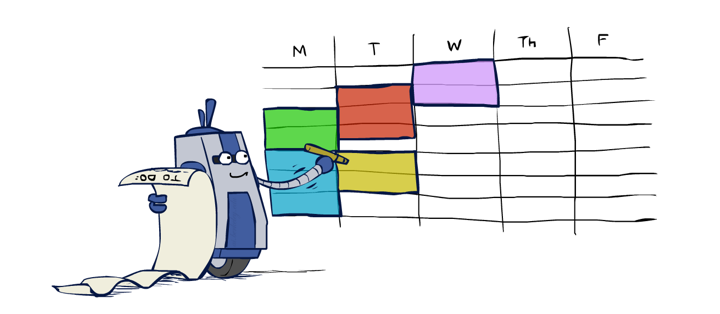
Cartoon credit to Ketrina Yim. Go, little scheduling bot, go!
In particular, you will gain practice with the following topics:
Backtracking: practice with implementing a backtracking approach to a real-world CSP.
Filtering / Constraint Propagation: practice reducing the work of a CSP solver through some clever preprocessing on variable domains.
Date Manipulation: practice using the Python
datetimeclass for processing representations of dates.
Overview
Want to revisit the course notes on the above? See below!
Your task in a nutshell:
You must schedule \(n\) meetings within some allowable date range. Each of these meetings will be indexed starting at 0.
Those meetings may have additional constraints (e.g., must occur before a certain date, must not conflict with another meeting).
A *solution* to this CSP will be some date assigned to each of the \(n\) meetings such that all constraints are satisfied.
This task decomposes into implementing 3 primary tools:
Backtracking: implement the backtracking algorithm, including how to manage variables, domains, and ascribe ordering to derive a solution from the recursion tree.
Node Consistency: perform node-consistency preprocessing to reduce domain cardinality and improve the performance of backtracking.
Arc Consistency: perform arc-consistency preprocessing to reduce domain cardinality and improve the performance of backtracking.
Example
In these problems, we'll be able to specify both:
Unary Constraints: specifying some domain restrictions on only one variable. These have the format:
L_VAL OP DATEwhereL_VALis some variable index,OPis some logical comparator in the set \(\lt, \gt, \lt=, \gt=, ==, !=\), andDATEis a... well... date!Binary Constraints: specifying some domain restrictions between two variables. These have the format:
L_VAL OP R_VALwith bothL_VAL, R_VALas variable indexes.
Consider the following example with 3 meetings to schedule (indexed \(0,1,2\)) in a date range between 2023-1-1 and
2023-1-3:
  X = {0, 1, 2}
  D_i = {2023-1-1, 2023-1-2, 2023-1-3}
  C = {
      // Unary Constraints:
      0 != 2023-1-2    // "Meeting 0 cannot occur on Jan. 2nd"
      2 < 2023-1-3     // "Meeting 2 must occur before Jan. 3rd"

      // Binary Constraints:
      0 != 1           // "Meetings 0 and 1 must be on separate days"
      1 == 2           // "Meetings 1 and 2 must be on the same day"
  }

  // Possible Solution:
  [2023-1-1, 2023-1-2, 2023-1-2]
  // Meeting 0 will occur on 2023-1-1
  // Meeting 1 will occur on 2023-1-2
  // Meeting 2 will occur on 2023-1-2
Simplifications and Assumptions
Before we detail the nitty-gritty, we should take a second to discuss some of the simplifying assumptions that we'll make regarding your deliverable:
We will only be encoding Unary and Binary constraints for this assignment, though it could easily be extended to support higher-order constraints (even though their utility isn't obvious for this application).
A submission that successfully implements backtracking, node consistency, and some form of constraint propagation will take no longer than ~8 seconds to complete any grading-CSP posed to it (usually, far less). Arbitrarily large problems may require more than that, but you can expect to be tested on problems larger, but not obscenely larger, to those given in the sample unit tests.
To represent Dates for this assignment, we will employ the Python's
datetimelibrary, which is useful for representing dates and times with ease. See the documentation here:
You don't have to fully understand all of the datetime uses and methods, but here are some at-a-glance niceties about them:
  # Constructing new datetimes:
  # datetime(year, month, day, ...)
  dt = datetime(2023, 1, 1)

  # Can compare datetimes using typical logical ops
  dt < datetime(2023, 1, 3) => True

  # Can add time to get new datetimes
  dt + timedelta(days=1) => datetime(2023, 1, 2)
Solution Skeleton
Start with the solution skeleton in-hand!
Included in the above, you'll find:
csp_solver.py, which is your one-stop-shop workhorse for the required parts of this assignment. Performing backtracking and implementing consistency checking must all be done inside here.date_constraints.py, which are used to encode the various date constraints placed on the meeting times. You may not modify these files, but should familiarize yourself with the methods they make available to you.csp_tests.py, which includes some unit tests to help you validate your implementation (you do not need to alter this file for this assignment, but, per usual, *probably should* to give yourself more confidence that your submission works for general formulations [read: the grading tests]).
There's also a BONUS part of this assignment that you have the option of completing (read on for more info:)
csp_local_solver.py, implements a LOCAL search solver of CSPs, and can be aided by the filtering methods you developed in yourcsp_solver.py.csp_local_tests.py, includes all tests you must pass to get full credit for your EC attempt.
Skeleton Overview

|
GenAI use for the entirety of this assignment is BANNED for code production as it will shortcut your learning and generalizable skills though is always OK for understanding error messages, interpreting skeleton code, etc. as outlined in the syllabus. |
Here's an outline for how we'll end up implementing the above:
Understand key parts of the given skeleton that you'll use in your implementation.
Implement your Backtracking CSP solver.
Implement Node Consistency Filtering.
Implement Arc Consistency Filtering.
[BONUS] Implement a Local Search CSP Solver.
Let's start by looking at how to programmatically implement and interface with our constraints, and then head to the solver from there.
Understanding DateConstraints
DateConstraints are those that constrain when meeting dates can occur by referencing each variable / meeting as a unique index, starting with index 0.
These are implemented for you in the date_constraints.py module, which uses a single class to represent both Unary and Binary constraints.
  class DateConstraint:
    """
    DateConstraints represent the conditions on how meetings are scheduled in
    the Calendar Satisfaction Problems (CSPs).

    Attributes:
        L_VAL (int):
            The index corresponding to one of the CSP meetings
        OP (str):
            The comparison operator like "==" or ">"
        R_VAL (int OR datetime):
            Depending on whether or not this DateConstraint is unary or binary,
            represents either the other meeting index or specific date against
            which to compare the given meeting in the L_VAL
        ARITY (int):
            How many variables appear in the DateConstraint: 1 for unary, 2
            for binary
    """
To initialize these attributes, we can use the constructor with choice of certain parameters to initialize either a Unary or Binary DateConstraint:
  def __init__(self, l_val: int, op: str, r_val: Union[int, datetime]):
      """
      Constructs a new DateConstraint with the given variables/datetime and relational
      operator.

      Parameters:
          l_val (int):
              The index of one of the variables being constrained
          op (str):
              The logical operator constraining the variable(s) in this DateConstraint.
              Legal choices for op can be found in DateConstraint._VALID_OPS
          r_val (Union[int, datetime]):
              Either the index of another variable being constrained (making this a
              Binary Date Constraint) or a datetime constraining the l_val (making
              this a Unary Date Constraint)

      [Unary Date Constraints]
          Constrain a single meeting by its index where the index is always the
          DateConstraint's L_VAL and the specific datetime is always the R_VAL
          Example:
              "Meeting 0 must occur on 1/3/2023"
              DateConstraint(0, "==", datetime(2023, 1, 3))

      [Binary Date Constraints]
          Constrain two meetings by their indexes where both L_VAL and R_VAL are
          meeting indexes
          Example:
              "Meeting 0 must occur sometime before meeting 1"
              DateConstraint(0, "<", 1)
      """
Understanding csp_solver.py
A Calendar Satisfaction Problem is implemented and solved by the solve method, which is tasked with returning a list of datetimes
that satisfy all of its constraints, where the list's datetimes are indexed by the meeting / variable they are assigned-to.
  def solve(n_meetings: int, date_range: set[datetime], constraints: set[DateConstraint]) -> Optional[list[datetime]]:
      """
      When possible, returns a solution to the given CSP based on the need to
      schedule n meetings within the given date range and abiding by the given
      set of DateConstraints.
        - Implemented using the Backtracking exact solution method
        - May return None when the CSP is unsatisfiable

      Parameters:
          n_meetings (int):
              The number of meetings that must be scheduled, indexed from 0 to n-1
          date_range (set[datetime]):
              The range of datetimes in which the n meetings must be scheduled; by default,
              these are each separated a day apart, but there's nothing to stop these from
              being meetings scheduled down to the second
              [!] WARNING: AVOID ALIASING -- Remember that each variable must have its
              own domain but what's provided is a single reference to a set of datetimes
          constraints (set[DateConstraint]):
              A set of DateConstraints specifying how the meetings must be scheduled.
              See DateConstraint documentation for different types of DateConstraints
              that might be found, and useful methods for implementing this solver.

      Returns:
          Optional[list[datetime]]:
              If a solution to the CSP exists:
                  Returns a list of datetimes, one for each of the n_meetings, where the
                  datetime at each index corresponds to the meeting of that same index
              If no solution is possible:
                  Returns None
      """
To see what this looks like, here's our same example from earlier, replicated in its Python equivalent:
  def test_csp_backtracking_EX(self) -> None:
      constraints = {
          # Unary Constraints
          DateConstraint(0, "!=", datetime(2023, 1, 2)),
          DateConstraint(2, "<", datetime(2023, 1, 3)),

          # Binary Constraints
          DateConstraint(0, "!=", 1),
          DateConstraint(1, "==", 2)
      }

      # Date range of 2023-1-1 to 2023-1-3 in which we must schedule 3 meetings,
      # indexed 0, 1, 2
      possible_dates = self.generate_dates(datetime(2023, 1, 1), 3)
      n_meetings = 3

      # Call our solver to try and assign meeting dates to each index
      solution = solve(n_meetings, possible_dates, constraints)

      # Example Solution:
      # [2023-01-01, 2023-01-02, 2023-01-02]
      #       0           1           2
      # |-------- Meeting Indexes ---------|

      self.validate_solution(n_meetings, solution, constraints)
With these examples in mind, let's get down to brass tacks with the actual tasks ahead of you:
Specifications
Task 1 - Backtracking
Task 1 - Implement Backtracking: given a CSP as specified above, implement a backtracking CSP solver with the following signature.
  def solve(n_meetings: int, date_range: set[datetime], constraints: set[DateConstraint]) -> Optional[list[datetime]]:
      """
      When possible, returns a solution to the given CSP based on the need to
      schedule n meetings within the given date range and abiding by the given
      set of DateConstraints.
        - Implemented using the Backtracking exact solution method
        - May return None when the CSP is unsatisfiable

      Parameters:
          n_meetings (int):
              The number of meetings that must be scheduled, indexed from 0 to n-1
          date_range (set[datetime]):
              The range of datetimes in which the n meetings must be scheduled; by default,
              these are each separated a day apart, but there's nothing to stop these from
              being meetings scheduled down to the second
              [!] WARNING: AVOID ALIASING -- Remember that each variable must have its
              own domain but what's provided is a single reference to a set of datetimes
          constraints (set[DateConstraint]):
              A set of DateConstraints specifying how the meetings must be scheduled.
              See DateConstraint documentation for different types of DateConstraints
              that might be found, and useful methods for implementing this solver.

      Returns:
          Optional[list[datetime]]:
              If a solution to the CSP exists:
                  Returns a list of datetimes, one for each of the n_meetings, where the
                  datetime at each index corresponds to the meeting of that same index
              If no solution is possible:
                  Returns None
      """
The following pseudocode can be helpful in implementing the above!
  function backtracking_search (variables, domains, constraints):
      return recursive_backtracker (list(), variables, domains, constraints)

  function recursive_backtracker (assignment, variables, domains, constraints):
      # Base case: all done!
      if assignment is complete: return assignment

      next_var = select_unassigned_variable(variables)
      for each value in order_domain_values(domains[next_var]):
          add next_var = value to assignment
          if assignment is still consistent with constraints:
              result = recursive_backtracker(assignment, variables, domains, constraints)
              if result is not a failure: return result
          # If we get here, that value from our assignment didn't work out, so remove it
          remove next_var = value from assignment

      # If we get here, ALL values in the domain of next_var failed, so backtrack:
      return failure
Some notes on the above:
To explain some of the pseudocode's components in greater detail:
select_unassigned_variable, order_domain_valuesare methods that might have exploited ordering heuristics like MRV and LCV, though you are not expected to implement those heuristics in this assignment, so any arbitrary choice of variable / value order will suffice here.Hint: since meetings are *indexed*, you can simply assign in indexed-order (i.e., meeting 0 first, then 1, then 2, etc.)
failureis some indication that at least one constraint has been violated, which can simply be represented asNonein Python.
You'll notice that
solveis a classless method, meaning you are *not* recording any of the state in attributes / global variables! Any state relevant to your solution will need to be passed by parameters alone.Read: You should not declare any global variables for your implementation!
Domains are provided as a list of set of datetimes to manage the domains of each variable, and remember that a solution returned by
solvewill be a list of dates where each date in that list corresponds to the index of the meeting it's assigned to.Aaaample helper methods apply here; the pseudocode above gives you a great outline such that anywhere you see something that looks functional, it's probably time to implement that behavior as a helper method!
Caveat: don't reinvent the wheel! I've given you a lot of helper methods in the provided classes. Make sure you're familiar with all of those before writing a lick of code!
You'll find one of the DateConstraint's methods particularly useful for the above...
  def is_satisfied_by_assignment(self, assignment: list[datetime]) -> bool:
      """
      Determines whether or not this DateConstraint is satisfied by the given assignment,
      which can either be a full or partial assignment of values to meeting variables,
      by index (e.g., index 1 of assignment would correspond to the datetime assigned to
      meeting 1).

      Parameters:
          assignment (list[datetime]):
              The list of assigned datetimes to meetings, by index, e.g.,
              [datetime(2023, 1, 1), datetime(2023, 1, 2)]

      Returns:
          True if EITHER:
              - The values assigned to this constraint's variables satisfy it, e.g.
                  assignment = [datetime(2023, 1, 1), datetime(2023, 1, 2)]
                  constraint = 0 < 1
              - The values of at least one variable in this constraint have not yet
                been assigned, e.g.,
                  assignment = [datetime(2023, 1, 1), datetime(2023, 1, 2)]
                  constraint = 3 == 1
          False if:
              - The values assigned to this constraint's variables do NOT satisfy it, e.g.,
                  assignment = [datetime(2023, 1, 1), datetime(2023, 1, 2)]
                  constraint = 1 == 0
      """
Once ready to test, fire up pytest -k test_csp_backtracking and what you'll notice is... you pass MOST of these tests, but several
may time out!
...that's because we need to do some filtering! Onwards!
Task 2 - Node Consistency
Task 2 - Implement Node Consistency Preprocessing: not a whole lot to say here! For any unary constraint, make sure to prune inconsistent values from the domains of variables that are mentioned. You will do so by implementing the following method.
  def node_consistency(domains: list[set[datetime]], constraints: set[DateConstraint]) -> None:
      """
      Enforces node consistency for all variables' domains given in the set of domains.
      Meetings' domains' index in each of the provided constraints correspond to their index
      in the list of domains.

      [!] Note: Only applies to Unary DateConstraints, i.e., those whose arity() method
      returns 1

      Parameters:
          domains (list[set[datetime]]):
              A list of domains where each domain is a set of possible date times to assign
              to each meeting. Each domain in the given list is indexed such that its index
              corresponds to the indexes of meetings mentioned in the given constraints.
          constraints (set[DateConstraint]):
              A set of DateConstraints specifying how the meetings must be scheduled.
              See DateConstraint documentation for different types of DateConstraints
              that might be found, and useful methods for implementing this solver.
              [!] Hint: see a DateConstraint's is_satisfied_by_values

      Side Effects:
          Although no values are returned, the values in any pruned domains are changed
          directly within the provided domains parameter
      """
Here's an example from the unit tests.
  def test_csp_node_consistency_t1(self) -> None:
      # Saying that meeting 0 must occur before Jan 3rd, 2023...
      constraints = {
          DateConstraint(0, "<", datetime(2023, 1, 3))
      }

      # ...but our possible dates span Jan 1st - 5th, 2023
      possible_dates = self.generate_dates(datetime(2023, 1, 1), 5)
      n_meetings = 1
      domains: list[set[datetime]] = [deepcopy(possible_dates) for n in range(n_meetings)]

      # As such, after performing node consistency...
      node_consistency(domains, constraints)

      # ...we'd expect 3 dates to be pruned: Jan 3rd - Jan 5th, leaving only 2 remaining:
      self.assertEqual(2, len(domains[0]))
      self.assertIn(datetime(2023, 1, 1), domains[0])
      self.assertIn(datetime(2023, 1, 2), domains[0])
The only hint here: note another of DateConstraint's methods here!
  def is_satisfied_by_values(self, left_date: datetime, right_date: Optional[datetime] = None) -> bool:
      """
      Determines whether or not this DateConstraint is satisfied by the provided
      left_date and right_date LITERALS, meaning that the input dates must not
      be variable indexes.

      [!] Essentially ignores the constraint's variable indexes in its L_VAL and R_VAL,
      trusting that the method's caller has faithfully supplied values from these domains.

      Parameters:
          left_date (datetime):
              The datetime to insert for this constraint's L_VAL
          right_date (Optional[datetime]):
              If NOT None:
                  The datetime to insert for this constraint's R_VAL
              If None:
                  For Unary Date Constraints, will use the constraint's R_VAL date,
                  but will raise a ValueError if left None for a Binary Date Constraint

      Returns:
          True when the L_VAL = left_date and R_VAL = right_date, the constraint is satisfied
          False otherwise

      Examples:
          unary_dc  = DateConstraint(2, ">", datetime(2023, 1, 3))
          binary_dc = DateConstraint(0, "<", 1)

          unary_dc.is_satisfied_by_values(datetime(2023, 1, 5)) => True
          binary_dc.is_satisfied_by_values(datetime(2023, 1, 5), datetime(2023, 1, 4)) => False
      """
Time to test! See if your nodes are happy with: pytest -k test_csp_node_consistency
Task 3 - Arc Consistency
Task 3 - Implement AC-3 Preprocessing: For any binary constraint, prune values from the domains of each variable that will never satisfy the relation by the mechanics of the AC-3 algorithm. You will do so by implementing the following method:
  def arc_consistency(domains: list[set[datetime]], constraints: set[DateConstraint]) -> None:
      """
      Enforces arc consistency for all variables' domains given in the set of domains.
      Meetings' domains' index in each of the provided constraints correspond to their index
      in the list of domains.

      [!] Note: Only applies to Binary DateConstraints, i.e., those whose arity() method
      returns 2

      Parameters:
          domains (list[set[datetime]]):
              A list of domains where each domain is a set of possible date times to assign
              to each meeting. Each domain in the given list is indexed such that its index
              corresponds to the indexes of meetings mentioned in the given constraints.
          constraints (set[DateConstraint]):
              A set of DateConstraints specifying how the meetings must be scheduled.
              See DateConstraint documentation for different types of DateConstraints
              that might be found, and useful methods for implementing this solver.
              [!] Hint: see a DateConstraint's is_satisfied_by_values

      Side Effects:
          Although no values are returned, the values in any pruned domains are changed
          directly within the provided domains parameter
      """
Here's an example from the unit tests:
  def test_csp_arc_consistency_t1(self) -> None:
      # Meeting 0 must occur before meeting 1
      constraints = {
          DateConstraint(0, "<", 1)
      }

      # ...and we have a possible range of dates from Jan 1 - Jan 5
      possible_dates = self.generate_dates(datetime(2023, 1, 1), 5)
      n_meetings = 2
      domains: list[set[datetime]] = [deepcopy(possible_dates) for n in range(n_meetings)]

      # So, after running AC-3...
      arc_consistency(domains, constraints)

      # ...we should recognize that meeting 0 cannot occur on Jan 5 or else there would
      # no date in the domain of meeting 1 that works...
      self.assertNotIn(datetime(2023, 1, 5), domains[0])
      # ...and vice versa for meeting 1
      self.assertNotIn(datetime(2023, 1, 1), domains[1])
      self.assertEqual(4, len(domains[0]))
      self.assertEqual(4, len(domains[1]))
Notes for implementing this behavior:
Note that you *do not* have to perform AC-3 *during* the course of backtracking for this assignment -- the preprocessing demands that you only do so before the backtracking process begins.
Smart helper methods will be the key to success here; refer to the AC-3 pseudocode from the associated lecture to get a gist for what to implement by focusing on the parts of the pseudocode that are written in functional notation -- this generally hints that it's time to write a helper! Here's that pseudocode:
  function ac_3 (variables, domains, constraints):
      arc_set = initialize_arcs(constraints)
      while arc_set not empty:
          curr_arc = get any arc from the arc set
          if remove_inconsistent_values(domains, curr_arc):
              for each arc (X -> curr_arc.TAIL) from constraints:
                  add (X -> curr_arc.TAIL) to arc_set

  function remove_inconsistent_values(domains, curr_arc):
      removed = False
      for each tail_val in domain of curr_arc.TAIL:
          if no head_val satisfies curr_arc.CONSTRAINT:
              remove tail_val from domain of curr_arc.TAIL
              removed = True
      # Return whether or not we pruned anything from TAIL domain, since
      # that will predicate whether or not we re-add neighbors to the arc_set
      return removed
To help manage the AC-3 Algorithm, I've provided you with an Arc helper class in csp_solver.py
  class Arc:
      """
      Helper Arc class to be used to organize domains for pruning during the AC-3
      algorithm, organized as (TAIL -> HEAD) Arcs that correspond to a given
      CONSTRAINT.

      [!] Although you do not need to, you *may* modify this class however you see
      fit to accomplish the arc_consistency method

      Attributes:
          CONSTRAINT (DateConstraint):
              The DateConstraint represented by this arc
          TAIL (int):
              The index of the meeting variable at this arc's tail.
          HEAD (int):
              The index of the meeting variable at this arc's head.

      [!] IMPORTANT: By definition, the TAIL = CONSTRAINT.L_VAL and
      HEAD = CONSTRAINT.R_VAL
      """

      def __init__(self, constraint: DateConstraint):
          """
          Constructs a new Arc from the given DateConstraint, setting this Arc's
          TAIL to the constraint's L_VAL and its HEAD to the constraint's R_VAL

          Parameters:
              constraint (DateConstraint):
                  The constraint represented by this Arc
          """
Reminders on the above:
Arcs have a HEAD, TAIL, and CONSTRAINT that they represent where the TAIL of the Arc should correspond to the L_VAL of their CONSTRAINT, and vice versa for the R_VAL and HEAD.
Remember the above when re-adding neighbors into the arc_set of AC-3!
To help you keep these in order, note the
DateConstraint'sget_reverse()method!
Ready to test if your AC-3 is cool enough? Try it out with: pytest -k test_csp_arc_consistency
Integration Testing
Once implemented, BOTH node_consistency and arc_consistency preprocessing should be integrated into your solve method!
Having successfully completed the picture, you can now spin up the full pytest csp_tests.py and those pesky timeouts should be gone!
Extra Credit
Warning: You may ONLY attempt the extra credit component of this assignment if ALL required Tasks in the Specifications above have been implemented successfully!
That said, if all is green above, the Extra Credit component is to re-do solve using LOCAL Search by implementing the local_solve
method in csp_local_solver.py
using a Local Search strategy that employs: (1) hillclimbing with simulated annealing or (2) a genetic algorithm with artificial evolution.
The bonuses for successfully accomplishing these? Bonus HW Points! +8 for the Simulated Annealing approach OR +12 for the Artificial Evolution approach.
Added Specifications
The specifications for the local_solve method are the same as in Task 1 in the specifications above!
  def local_solve(n_meetings: int, date_range: set[datetime], constraints: set[DateConstraint]) -> Optional[list[datetime]]:
      """
      When possible, MAY return a solution to the given CSP based on the need to
      schedule n meetings within the given date range and abiding by the given
      set of DateConstraints.
        - Implemented using a Local Search Approximate solution method
        - May return None when the CSP is unsatisfiable or when the solver got unlucky
          and ran out of random restarts to succeed

      [!] Two important Constants in this file dictate behavior of the local solver:
        - MAX_STEPS = the number of steps that the solver should take from any one
          random initial state
        - MAX_RESTARTS = the number of random restarts the local solver may take before
          giving up and returning None

      [!] If attempting a genetic algorithm, may add any constants to the top of this
          file as deemed necessary

      Parameters:
          n_meetings (int):
              The number of meetings that must be scheduled, indexed from 0 to n-1
          date_range (set[datetime]):
              The range of datetimes in which the n meetings must be scheduled; by default,
              these are each separated a day apart, but there's nothing to stop these from
              being meetings scheduled down to the second
              [!] WARNING: AVOID ALIASING -- Remember that each variable must have its
              own domain but what's provided is a single reference to a set of datetimes
          constraints (set[DateConstraint]):
              A set of DateConstraints specifying how the meetings must be scheduled.
              See DateConstraint documentation for different types of DateConstraints
              that might be found, and useful methods for implementing this solver.

      Returns:
          Optional[list[datetime]]:
              If a solution to the CSP exists:
                  Returns a list of datetimes, one for each of the n_meetings, where the
                  datetime at each index corresponds to the meeting of that same index
              If no solution is possible:
                  Returns None
              If the MAX_RESTARTS are reached:
                  Returns None
      """
There are some distinct details you'll want to pay attention to:
Note that
csp_local_solver.pyimports your primarycsp_solver.pymethods, meaning you can re-use the Filtering algorithms you wrote for Tasks 2 + 3 (or other helpers that you wrote there).Note also the presence of some constants at the top of
csp_local_solver.pythat you should use where appropriate in your implementation (and kept at the values I gave). You may add to these, but those given include:MAX_STEPS, the number of steps during one hillclimbing w/ simulated annealing start from a random state, or the max number of generations to try in the artificial evolution approach. If your solver tries this many steps during a single attempt without finding a solution, it will then attempt a random restart if any are left (see next bullet).MAX_RESTARTS, the number of random restarts the strategy will attempt before giving up and concluding that there is no solution (even if there is and it just got unlucky in those 100 attempts). In hillclimbing this means beginning again with a new random initial state at the start of each attempt, and in artificial evolution, this means beginning again with a new random population.Your additions: any constants you'd like to add to the solution may go here as well, including parameters for a cooling schedule in simulated annealing or the generation size in artificial evolution.
Whatever your approach, it should begin as in the main assignment with Filtering preprocessing using Node and Arc Consistency (again, inherited from
CSPSolver).The rest is up to you! This is more of a "blank page" assignment because it's extra credit -- show me how much you've learned and can apply without careful guidance from the skeleton!
The extra credit tests are given in csp_local_tests.py, so once you have a solution and are ready to tackle the big-boi, try pytest csp_local_tests.py
Hints
Some challenges, tips, and hints to consider:
This assignment is meant to be the culmination of the programmatic tools, tricks, and tips that we've covered and used throughout the semester, so the skeleton is a bit on the lighter side -- remember you data structures and do your best to develop an organized gameplan from the start!
Check out the
validate_solutionmethod incsp_tests.pyfor some inspiration for how you might catch backtracking conditions in your csp_solver.Function getting out-of-hand complicated? Remember to use ample helper methods! Be particularly conscious of repeated code.
Additionally, here's a good order of tasks to tackle:
Review your course notes and Classwork 6 to make sure you have a solid grasp on how CSPs are defined and solved (though the spec might be published before we've seen CW 6, so you can go over the notes to start!).
Not sure where to start? Write down the steps that you want to accomplish in plain English first, then translate to pseudocode comments, then translate to actual code.
Develop incrementally! Don't try to do everything at once. Start with backtracking, then move to node consistency, and only then to arc.
Test thoroughly! You should be sure your solution handles a wide swath of input CSPs.
Start early and ask questions! I'm here to help!
Testing & Grading
Required Portion Testing & Grading
This is a challenging assignment, but you can still get a lot of partial credit if you're unable to finish the whole thing!
Successfully completing
solvewill net you ~70% credit.Successfully implementing
node_consistencywill add ~+10% on top of that, with successfularc_consistencythe remaining 20%.
You can implement solve independently from the consistency filters (so start with it since it's the largest amount of credit), and node_consistency
is pretty short.
Give yourself ample time for AC-3, it's probably the trickiest of the 3!
EXTRA CREDIT Testing & Grading
Note: Tests for the extra credit are SEPARATE from the original assignment's and are found in csp_local_tests.py.
There are some important differences in this set of tests now that we're in the domain of Local Search:
Note in the
log_outcometest helper, we repeat the same test some number of times to see if it meets some threshold of successes. This is required because, as we know, local search methods are not complete, so even a successful implementation may get unlucky and fail once or twice. Because of this, a local search CSP is said to be passed if it succeeds 8/10 times (for this assignment), though a good implementation shouldn't need more than a single test of grace.
Note: You must have a separate implementation of hillclimbing or artificial evolution in csp_local_solver.py to receive
any extra credit; using your backtracking solver or anything resembling the main assignment here will not receive credit, even if some of these tests pass.
IMPORTANT: If you're attempting the extra credit, make sure to check the appropriate box in the README.md!
Submission
You will be submitting your assignments through GitHub Classroom!
What
Complete the required methods in csp_solver.py (and, for the extra credit, csp_local_solver.py) that accomplishes the specification above,
*in the exact project structure and package given* in the skeleton above.
You must NOT modify any class' *public interface* (i.e., any public class or method signatures) in your submission!
Per usual, feel free to add any private helpers that you find useful.
How
To clone this assignment (if you need a refresher), consult the guide here:
To submit this assignment:
Simply push your final, submission copy to the GitHub Classroom repository associated with your account.
Place your name at the top of *all* submitted files (in appropriate JavaDoc commenting fashion) AND in the accompanying
readmefile.